Geometric Tattoos: Styles, Meanings, Designs, and Placement Ideas
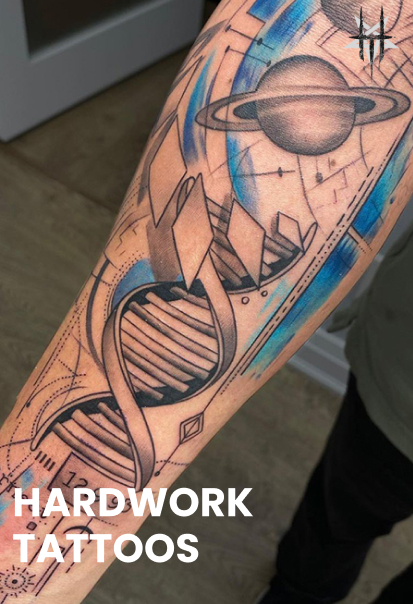
Geometric tattoos create structured visuals that combine lines, symmetry, ratios, and symbolic forms. The style attracts people who appreciate clarity, balance, and meaning in their body art. A geometric tattoo often delivers a calm and measured aesthetic because every line, angle, or curve contributes to a unified design.
Book Your Landscape Tattoos Appointment at Hardwork Tattoos
What Are Geometric Tattoos?
Geometric tattoos rely on accurately formed shapes, precisely measured lines, and harmonious compositions that create an organized visual story. The structure of a geometric tattoo often reflects natural patterns such as honeycombs, spirals, or constellations. People appreciate the clarity of these designs because symmetry creates a grounding effect that enhances the tattoo’s presence on the skin. Many individuals also explore geometric tattoos when they want a versatile style that adapts to small or large placements without losing definition. Interest usually increases once people notice how geometric components mimic natural forms, architectural influences, or spiritual patterns.
Symbolic associations also play a strong role in geometric tattoo selection. A triangle can represent direction, a circle can represent continuity, and a hexagon can represent harmony. These symbolic cues encourage people to choose geometric tattoos for personal expression rather than decoration alone. Each geometric tattoo maintains visual order while presenting a meaning that develops across shapes and lines.
Geometric Wing-Based Tattoo Designs
Geometric wing tattoos combine structured shapes with flowing outlines to create a striking blend of order and movement. A geometric wing tattoo usually features angular segments arranged in balanced patterns that mimic feathers. People gravitate toward this concept because wings represent freedom, elevation, or transformation, while geometric structure adds clarity to the symbolism. The interplay between sharp lines and soft curves creates a layered visual effect that appeals to many tattoo enthusiasts.
Geometric wings also encourage personalization because each wing can contain unique elements. Some individuals prefer mandala-inspired segments that form feather-like patterns, while others choose straight-line shapes that simplify the silhouette. Each version modifies the tone of the tattoo. Mandala wings appear intricate, while linear wings appear modern and minimal. Many people explore geometric wings for the back, shoulders, or forearms because these areas provide enough space for symmetrical detailing.
A geometric wings tattoo can include additional shapes that create a unified flow across the body. Triangles often emphasize direction, while circles create a grounding center. These shapes guide the eye outward toward the wingtips.
The Best Geometric Tattoo Options for Different Body Placements
Geometric tattoos adapt well to various body placements because line-based designs expand or contract without losing structural clarity. People often begin placement research once they select a general aesthetic. Each region allows a different type of geometric tattoo to stand out. Larger areas support complex wings or mandalas, while smaller regions support compact shapes and symbols. The following table highlights popular placements and ideas.
Body Area | Suitable Geometric Designs | Visual Impact |
Arm | Bands, symmetrical shapes, stacked triangles | Creates structured flow that wraps around the limb |
Back | Geometric wings, large mandalas, interconnected shapes | Provides a wide surface for detail-heavy compositions |
Side / Ribs | Geometric side tattoo using linear cascades or tall forms | Emphasizes vertical movement through long silhouettes |
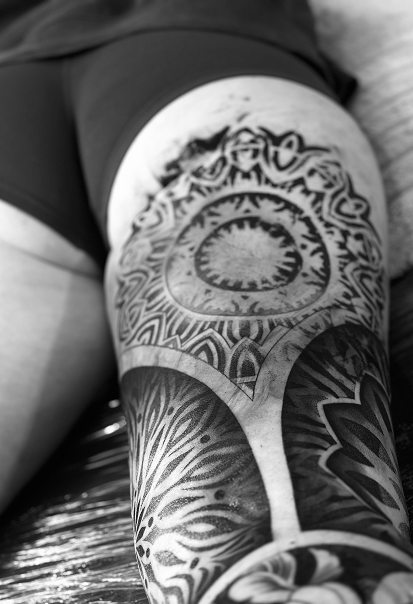
Thigh | Circular mandalas, abstract symmetry | Allows bold patterns without overcrowding |
Calf | Vertical lines, mirrored shapes | Enhances natural contours of the lower leg |
A geometric side tattoo often becomes a favorite choice due to its natural alignment with elongated shapes. People who prefer visual continuity usually explore ribcage designs that follow the body’s curvature. Exploration of geometric components becomes the next step once placement decisions start forming.
What Are The Geometric Elements That You Can Use to Build Tattoo Designs?
Geometric tattoos depend on carefully chosen elements, so understanding components helps people imagine more original possibilities. Lines create direction, shapes establish structure, and patterns introduce rhythm. Each element maintains its function within a geometric tattoo, and the relationship between components determines the final design.
Lines guide movement across the tattoo. Parallel lines emphasize calm progression, while intersecting lines create complexity. Shapes define the foundation of the design. Triangles create pathways, circles create harmony, and hexagons create stability. Patterns unite these shapes through repetition. Mandalas present spiritual balance, tessellations create mathematical beauty, and dotwork introduces subtle texture.
A list of commonly used geometric elements includes the following.
- Create direction with straight or angled lines
- Form structure with triangles, circles, squares, and hexagons
- Build rhythm with mandala segments or tessellation patterns
- Add texture with dotwork shading
- Establish depth with overlapping shapes
People who understand these elements start exploring shape-based inspirations next, which naturally guides the reading flow into the next section.
Shape-Based Geometric Tattoo Ideas
Shape-driven geometric tattoos appeal to people who appreciate simplicity paired with meaning. Triangles create direction, growth, or balance based on their orientation. Many individuals position them on the wrist or collarbone because the shape stays visually clean in small formats. Circles create completeness or unity. A simple circle tattoo often appears on the forearm or shoulder, where the rounded form enhances the natural curvature of the body. Squares create structure and grounding. People often choose the ankle or ribs for square tattoos because a static shape creates contrast against body movement. Some shape-based inspirations are listed below for your reference.
- Create progression with stacked triangles in ascending patterns
- Build calm energy using thick or thin circles arranged around a central point
- Form structure with repeating squares or diamond shapes
- Explore movement using overlapping shapes that merge into abstract geometry
- Present contrast using single-line shapes in empty space
Popular Minimalistic Geometric Tattoo Styles
Minimal geometric tattoos appeal to individuals who prefer subtle expression with a modern feel. Clean lines, simple shapes, and open spacing create designs that feel lightweight while still carrying symbolic meaning. The shift toward minimalism occurs naturally after exploring shape-based ideas because many geometric shapes function well in simplified formats.
Minimal geometric tattoos often rely on thin-line triangles, delicate circles, or small symbols placed on areas like the fingers, ankles, or collarbone. These placements support understated designs that remain visible without dominating the surrounding skin. Many people choose minimal geometric tattoos when they want art that reflects calmness or clarity. The absence of heavy shading draws attention to the accuracy of each line, which is why artists with precision-focused portfolios often excel in this style.
A set of common minimalist approaches includes:
- Create micro tattoos using single-line triangles
- Form clean compositions using tiny circles paired with dots
- Present subtle movement using short linear arrangements
- Build abstract forms using two or three shapes arranged with generous spacing
- Explore small placements that complement minimalist detail